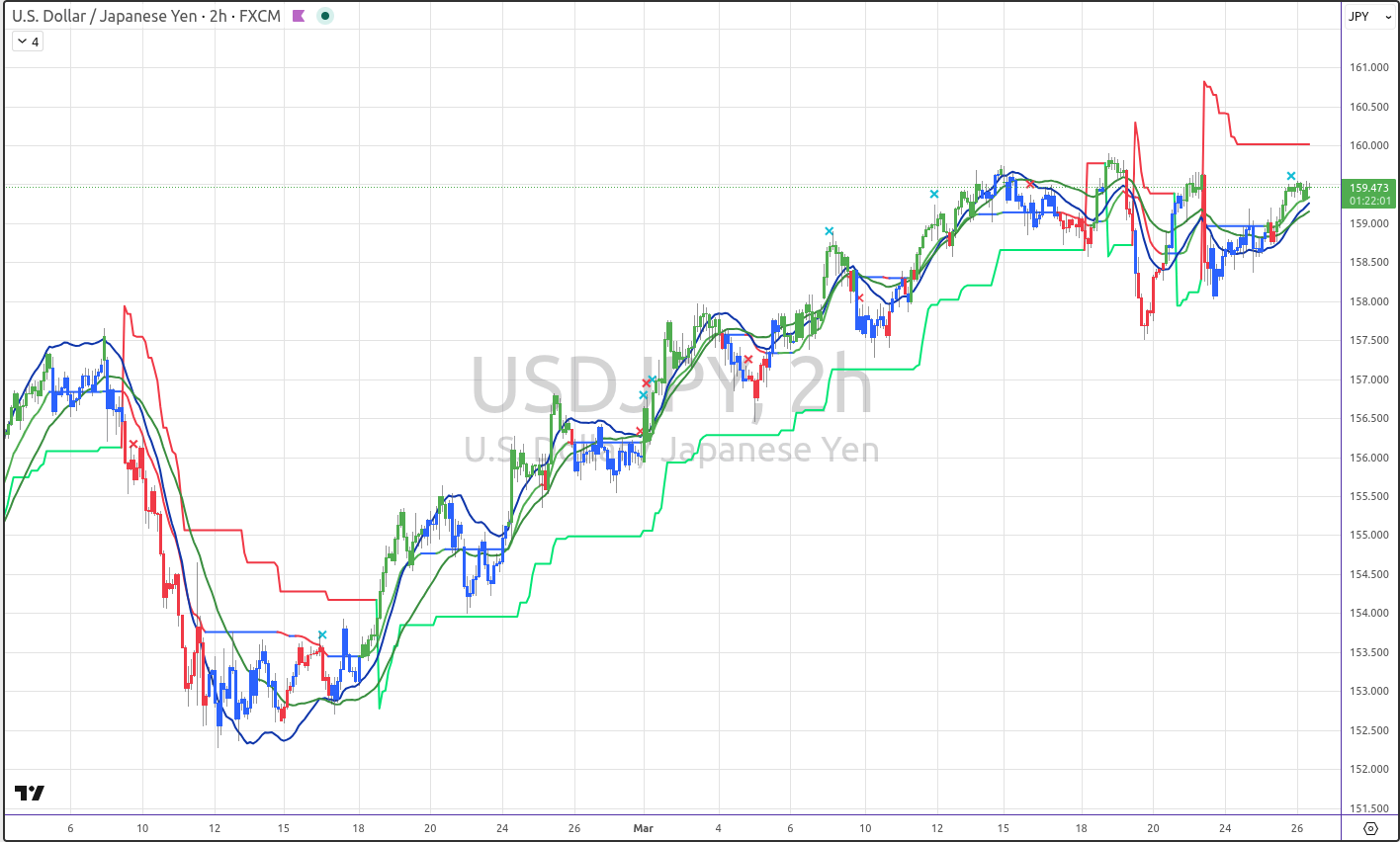
For a currency trader, the level of 160.00 on the USDJPY is not merely a number on a screen; it represents the ‘event horizon’ of a profound structural crisis. While a 2-hour chart might show a simple rejection at 159.50, that price action is the visible tip of a submerged iceberg consisting of failed diplomacy, a resource-draining proxy war, and a looming collapse of the global carry trade.
The Energy Transmission and the Policy Wall
The fundamental driver of the Yen’s current weakness is not simple speculation, but a ‘Terms of Trade’ crisis. Japan is a nation that must import nearly all of its energy, and those imports are settled in US Dollars. When global tensions drive crude oil toward $120 a barrel, Japanese corporations are forced into a relentless, mechanical cycle: they must sell Yen and buy Dollars just to keep the lights on.
This creates a self-reinforcing loop. The more the Yen weakens, the more expensive energy becomes in local terms, which in turn necessitates more Yen-selling to cover the bill. Traditional intervention—where the Bank of Japan simply sells Dollars from its reserves—has proven insufficient because it only treats the symptom. This has led to the emergence of the ‘Katayama Gambit’, a rumoured shift in strategy where the Japanese Ministry of Finance may attempt to short oil futures directly. By attacking the price of energy, Japan hopes to break the correlation that is hollowing out its currency from the inside.
The Diplomacy of Liquidation
The backdrop to this economic strain is a diplomatic chasm in the Middle East. The much-discussed ‘15-Point Plan‘ is often framed in the media as a peace negotiation, but a closer look at its requirements reveals a different reality. The plan demands that Iran dismantle its regional architecture, ship its uranium stockpiles abroad, and surrender control of the Strait of Hormuz—effectively declaring it a free maritime zone.
For a regime that views its regional influence and missile deterrents as existential necessities, these terms are not a basis for negotiation; they are a liquidation notice. This disconnect explains why Tehran claims the US is ‘negotiating with itself’. As long as these demands remain the only path to ‘peace’, the market recognises that a resolution is unlikely. Consequently, the ‘War Premium’ remains embedded in the Dollar, and the threat to the world’s most critical energy chokepoint remains active, keeping the pressure on Japan’s trade balance.
The Attrition Trap and the Caspian Black Hole
The resilience of the Iranian military, despite claims of ‘90% degradation’, stems from a geographical and political reality often overlooked in Western analysis. The Caspian Sea functions as a ‘Black Hole’ for international oversight, allowing Russia and Iran to maintain a private logistical bridge. Simultaneously, industrial precursors and dual-use components continue to flow from Chinese ports like Gaolan, providing the ‘ingredients’ for asymmetric warfare.
This creates a strategic ‘Attrition Trap’ for the United States. By keeping a ‘dwindled’ Iranian force active, Russia and China are forcing the US to expend high-end munitions and carrier readiness in the Persian Gulf. Every million-dollar interceptor used to stop a cheap drone is a missile taken away from the ‘Taiwan Shield’ in the Pacific. This drain on US resources ensures the conflict lingers, which in turn ensures that oil prices stay elevated and the Yen stays pinned to the mat.
The Technology of Time
The US military is currently racing to flip the maths of this attrition. The ‘stupidity’ of using multi-million dollar missiles to hit low-cost drones is a known vulnerability that the Pentagon is attempting to solve through ‘Drone Dominance’ and directed energy. New systems like airborne lasers (XCalibur and Sting) and low-cost interceptor swarms are being fast-tracked to the theatre.
However, the barrier is not just engineering, but physics. In the humid, salt-heavy air of the Gulf, lasers face significant scattering and range issues. Until these ‘smart’ defences are ubiquitous and reliable, the US remains trapped in a high-cost defensive posture. Traders watch this technological race because the moment the US can successfully ‘mow the grass’ of a drone swarm for pennies on the pound, the ‘War Premium’ on the Dollar may finally begin to evaporate.
The Shifting Mirage of Safe Havens
In the midst of this volatility, the concept of a ‘Safe Haven’ has undergone a radical transformation. Historically, both the US Dollar and the Japanese Yen were viewed as bunkers where capital could weather any storm. However, the current conflict has exposed the structural fragility of both. Japan’s decades of economic stagnation and its total dependence on energy imports make the Yen feel less like a haven and more like a liability in a prolonged energy war. Similarly, the US is navigating its own fiscal mess, with high debt and the strategic strain of a two-front geopolitical commitment.
Traders are beginning to look beyond these traditional giants for ‘true’ safety. The Swiss Franc (CHF) remains a fortress of fiscal discipline, while the Singapore Dollar (SGD) has emerged as the ‘Vault of the East’, physically and politically removed from the immediate ‘obliteration’ zones. Even the commodity currencies—the Australian Dollar (AUD), Canadian Dollar (CAD), and Norwegian Krone (NOK)—are being re-evaluated. If the world is entering a permanent state of high energy and resource costs, these exporters may become the actual havens of the new era. For the Forex trader, the lesson is clear: safety is no longer a permanent label; it is a temporary condition determined by who has the most reliable supply lines and the least exposure to the ‘Energy Tax’.
The Final Domino: The Carry Trade
All these forces converge in the AUD/JPY cross-rate—the market’s ultimate ‘risk barometer’. For years, the Yen carry trade—where investors borrow cheap Yen to buy higher-yielding assets like the Australian Dollar—has been a cornerstone of global liquidity. But this trade requires stability.
As volatility increases and the Yen approaches the 160.00 ‘Kill Zone’, the risk-to-reward ratio for these trades collapses. A sudden spike in the Yen, triggered perhaps by a successful ‘oil short’ or a major intervention, would force a massive, global liquidation. Investors would be forced to sell their ‘risky’ assets (like AUD or tech stocks) to buy back the Yen they borrowed. This is the ‘last straw’ that turns a regional conflict and a currency imbalance into a systemic financial event.
In this landscape, the USDJPY at 159.50 is not just a chart pattern. It is the point where the cost of energy, the limits of military power, and the stability of the global financial system are all being tested simultaneously.


